ACTIVITY 1
Draw the Roller Coaster
Ages 7–9 · 15 min · Book link: Lab Notes, page 39
Read a line graph and connect it to the story.
You need: Printable graph sheet, two colored pencils
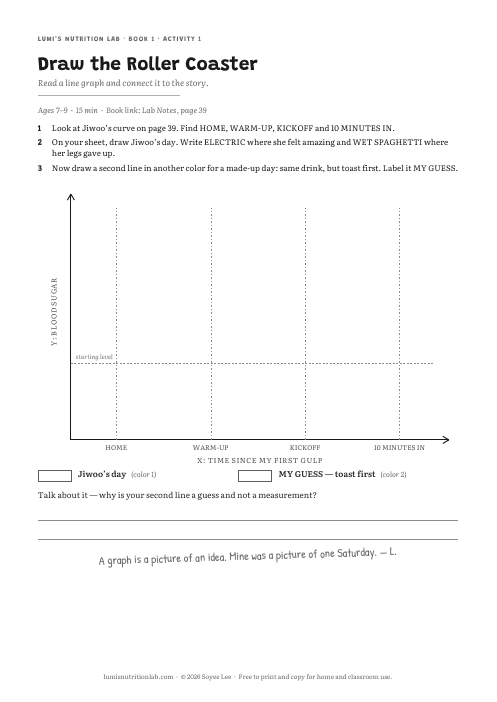
- Look at Jiwoo’s curve on page 39. Find HOME, WARM-UP, KICKOFF and 10 MINUTES IN.
- On your sheet, draw Jiwoo’s day. Write ELECTRIC where she felt amazing and WET SPAGHETTI where her legs gave up.
- Now draw a second line in another color for a made-up day: same drink, but toast first. Label it MY GUESS.
- Talk about it: why is your second line a guess and not a measurement?
A graph is a picture of an idea. Mine was a picture of one Saturday. — L.
For the grown-up: There is no answer key. Many children draw a lower, slower hill for the toast day — that matches the idea in Lumi’s notes, but praise any line the child can explain.
ACTIVITY 2
The Insulin Crew Relay
Ages 6–9 · 20–25 min · Book link: Chapter 6 and Lab Notes, pages 40–41
Model how insulin and working muscles move sugar out of the blood — and why two grabbers at once empty it fast.
You need: 20 paper “sugar cubes” (printable or crumpled paper), three boxes labeled BLOOD, CELLS and LEG MUSCLES, role cards, a timer
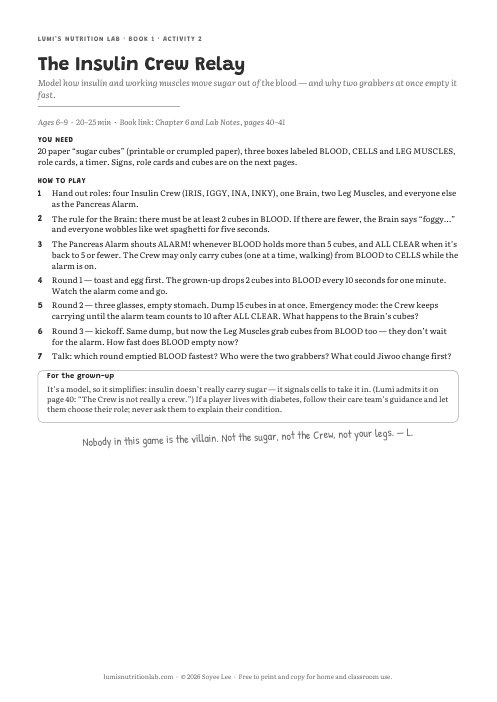
- Hand out roles: four Insulin Crew (IRIS, IGGY, INA, INKY), one Brain, two Leg Muscles, and everyone else as the Pancreas Alarm.
- The rule for the Brain: there must be at least 2 cubes in BLOOD. If there are fewer, the Brain says “foggy…” and everyone wobbles like wet spaghetti for five seconds.
- The Pancreas Alarm shouts ALARM! whenever BLOOD holds more than 5 cubes, and ALL CLEAR when it’s back to 5 or fewer. The Crew may only carry cubes (one at a time, walking) from BLOOD to CELLS while the alarm is on.
- Round 1 — toast and egg first. The grown-up drops 2 cubes into BLOOD every 10 seconds for one minute. Watch the alarm come and go.
- Round 2 — three glasses, empty stomach. Dump 15 cubes in at once. Emergency mode: the Crew keeps carrying until the alarm team counts to 10 after ALL CLEAR. What happens to the Brain’s cubes?
- Round 3 — kickoff. Same dump, but now the Leg Muscles grab cubes from BLOOD too — they don’t wait for the alarm. How fast does BLOOD empty now?
- Talk: which round emptied BLOOD fastest? Who were the two grabbers? What could Jiwoo change first?
Nobody in this game is the villain. Not the sugar, not the Crew, not your legs. — L.
For the grown-up: It’s a model, so it simplifies: insulin doesn’t really carry sugar — it signals cells to take it in. (Lumi admits it on page 40: “The Crew is not really a crew.”) If a player lives with diabetes, follow their care team’s guidance and let them choose their role; never ask them to explain their condition.
ACTIVITY 3
Four Things Were True at Once
Ages 7–9 · 15–20 min · Book link: Lab Notes, pages 42–43
Tell causes from coincidences, then plan a fair test that changes one thing.
You need: Printable cards and sorting mat, scissors
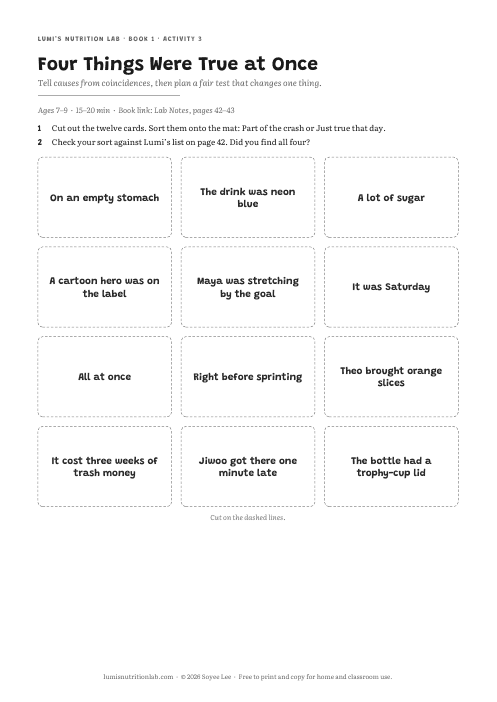
- Cut out the twelve cards. Sort them onto the mat: Part of the crash or Just true that day.
- Check your sort against Lumi’s list on page 42. Did you find all four?
- Look at the hero card again. The cartoon on the label didn’t change Jiwoo’s blood sugar — but did it change what she did?
- Pick ONE of the four to change and fill in the fair-test strip: I will change… I will keep the same… I will notice…
Change all four and you learn nothing. Change one and you learn one thing. That’s a lot. — L.
For the grown-up: The point is the method, not the food. Keep the fair test on paper — no tasting is needed or wanted.
ACTIVITY 4
Label Detective: FOR CHAMPIONS ONLY
Ages 7–9 · 20 min · Book link: Chapter 1 and Think Like a Scientist, page 47 (question 1)
Notice what a label or ad promises — and how a scientist would test the promise.
You need: Printable label sheet, pencils; optional: one real drink or snack package from home
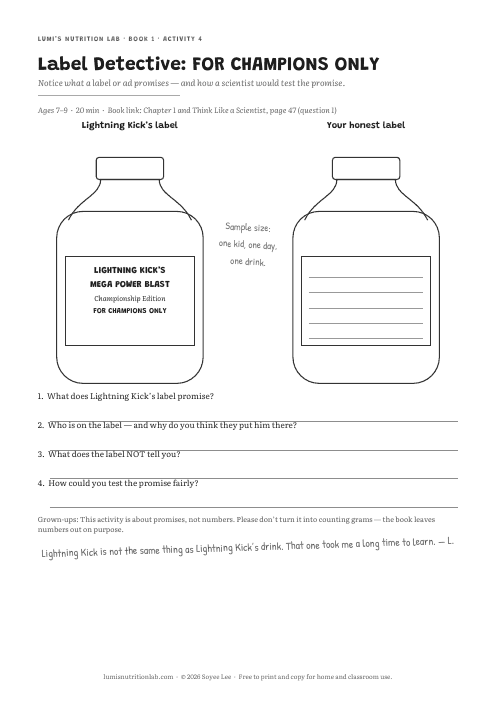
- Read Lightning Kick’s label on the sheet. What does it promise?
- Detective questions: Who is on the label, and why do you think they put him there? What does the label not tell you? How could you test the promise fairly?
- Design an honest label for Lightning Kick’s drink. Lumi’s case file on page 38 might help: “Sample size: one kid, one day, one drink.”
- Bonus, with a grown-up: find one real package at home. Is its big claim a promise or a test result?
Lightning Kick is not the same thing as Lightning Kick’s drink. That one took me a long time to learn. — L.
For the grown-up: This activity is about promises, not numbers. Please don’t turn it into counting grams — the book leaves numbers out on purpose.
ACTIVITY 5
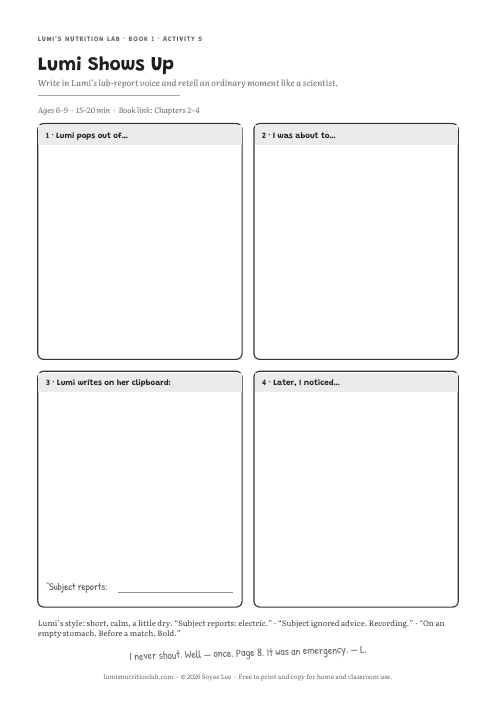
Lumi Shows Up
Ages 6–9 · 15–20 min · Book link: Chapters 2–4
Write in Lumi’s lab-report voice and retell an ordinary moment like a scientist.
You need: Printable four-panel comic sheet
- Panel 1: Lumi pops out of something in YOUR day — a cereal box, a puddle, a sock drawer.
- Panel 2: what were you about to do?
- Panel 3: what does Lumi write on her clipboard? Use her style: short, calm, a little dry. “Subject reports: electric.” “Subject ignored advice. Recording.”
- Panel 4: what did you notice later?
I never shout. Well — once. Page 8. It was an emergency. — L.
For the grown-up: Any answer works, including “Subject reports: nothing happened.” That is still data.
ACTIVITY 6
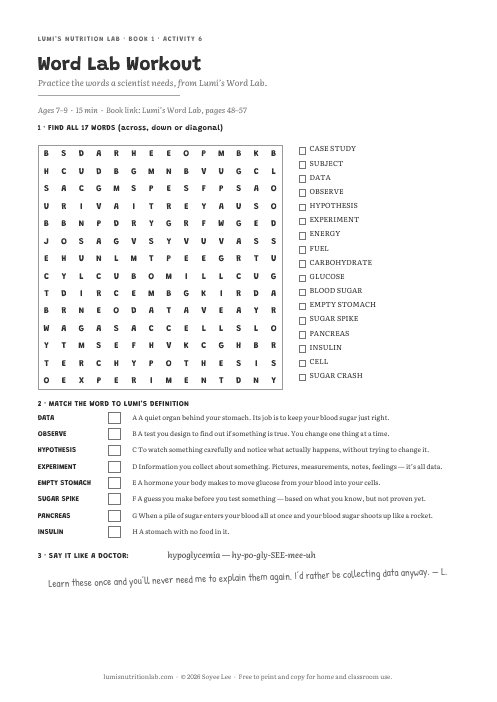
Word Lab Workout
Ages 7–9 · 15 min · Book link: Lumi’s Word Lab, pages 48–57
Practice the words a scientist needs, from Lumi’s Word Lab.
You need: Printable puzzle sheet
- Find all seventeen Word Lab words in the word search.
- Match eight words to Lumi’s definitions.
- Say it like a doctor: hypoglycemia — hy-po-gly-SEE-mee-uh.
Learn these once and you’ll never need me to explain them again. I’d rather be collecting data anyway. — L.
For the grown-up: The answers are on the second page — no peeking, junior scientists.
ACTIVITY 7
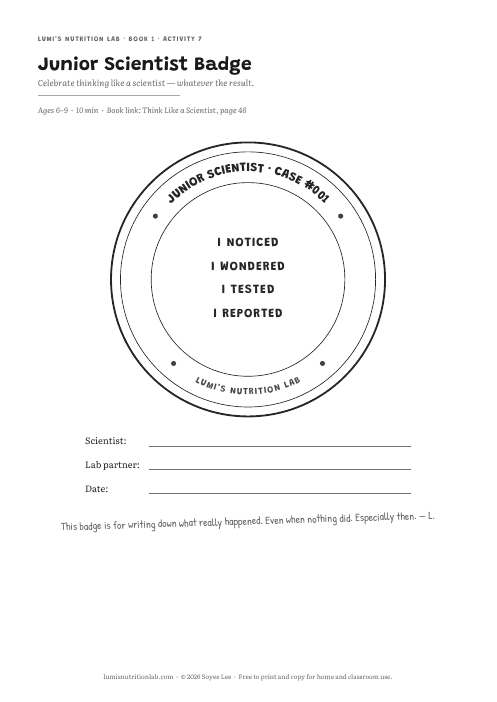
Junior Scientist Badge
Ages 6–9 · 10 min · Book link: Think Like a Scientist, page 46
Celebrate thinking like a scientist — whatever the result.
You need: Printable badge, coloring pencils
- Color the badge.
- Sign it — and have your lab partner sign too.
This badge is for writing down what really happened. Even when nothing did. Especially then. — L.
For the grown-up: Give it for honest observing, not for finishing a streak. Blank days count.