ACTIVITY 1
Draw the Sleepiness Pile
Ages 7–9 · 15 min · Book link: Lab Notes, page 42
Read a line graph and connect it to the story.
You need: Printable graph sheet, two colored pencils
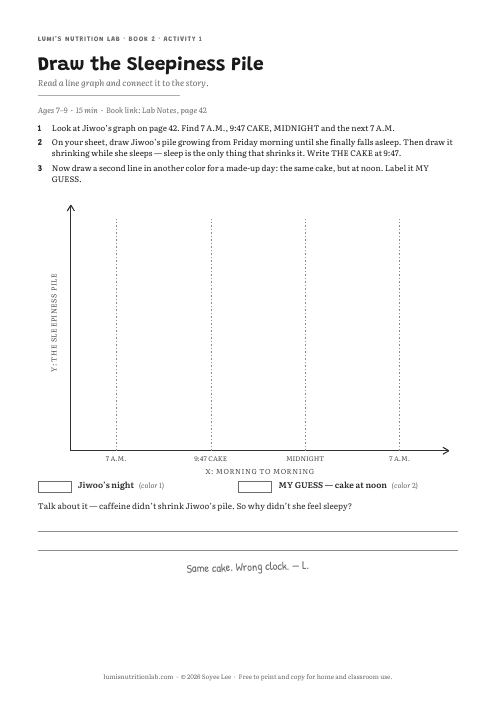
- Look at Jiwoo’s graph on page 42. Find 7 A.M., 9:47 CAKE, MIDNIGHT and the next 7 A.M.
- On your sheet, draw Jiwoo’s pile growing from Friday morning until she finally falls asleep. Then draw it shrinking while she sleeps — sleep is the only thing that shrinks it. Write THE CAKE at 9:47.
- Now draw a second line in another color for a made-up day: the same cake, but at noon. Label it MY GUESS.
- Talk about it: caffeine didn’t shrink Jiwoo’s pile. So why didn’t she feel sleepy?
Same cake. Wrong clock. — L.
For the grown-up: There is no answer key. The pile grows all day either way, and only sleep shrinks it — on page 42 it starts to fall once Jiwoo is asleep. With a noon cake, most of the caffeine is gone by bedtime, so the message gets through (page 45). Praise any line the child can explain. Step 4’s answer is on page 43: caffeine takes the chair, so the sleepy message can’t get through as well.
ACTIVITY 2
The Sleepiness Chair Game
Ages 6–9 · 20–25 min · Book link: Chapter 6 and Lab Notes, pages 42–45
Model how caffeine blocks the sleepiness signal — and why the same cake at noon and at 9:47 p.m. makes two different nights.
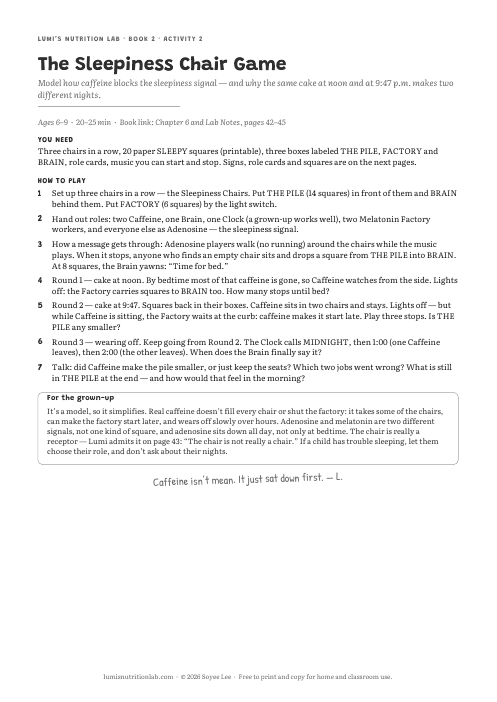
You need: Three chairs in a row, 20 paper SLEEPY squares (printable), three boxes labeled THE PILE, FACTORY and BRAIN, role cards, music you can start and stop
- Set up three chairs in a row — the Sleepiness Chairs. Put THE PILE (14 squares) in front of them and BRAIN behind them. Put FACTORY (6 squares) by the light switch.
- Hand out roles: two Caffeine, one Brain, one Clock (a grown-up works well), two Melatonin Factory workers, and everyone else as Adenosine — the sleepiness signal.
- How a message gets through: Adenosine players walk (no running) around the chairs while the music plays. When it stops, anyone who finds an empty chair sits and drops a square from THE PILE into BRAIN. At 8 squares, the Brain yawns: “Time for bed.”
- Round 1 — cake at noon. By bedtime most of that caffeine is gone, so Caffeine watches from the side. Lights off: the Factory carries squares to BRAIN too. How many stops until bed?
- Round 2 — cake at 9:47. Squares back in their boxes. Caffeine sits in two chairs and stays. Lights off — but while Caffeine is sitting, the Factory waits at the curb: caffeine makes it start late. Play three stops. Is THE PILE any smaller?
- Round 3 — wearing off. Keep going from Round 2. The Clock calls MIDNIGHT, then 1:00 (one Caffeine leaves), then 2:00 (the other leaves). When does the Brain finally say it?
- Talk: did Caffeine make the pile smaller, or just keep the seats? Which two jobs went wrong? What is still in THE PILE at the end — and how would that feel in the morning?
Caffeine isn’t mean. It just sat down first. — L.
For the grown-up: It’s a model, so it simplifies. Real caffeine doesn’t fill every chair or shut the factory: it takes some of the chairs, can make the factory start later, and wears off slowly over hours. Adenosine and melatonin are two different signals, not one kind of square, and adenosine sits down all day, not only at bedtime. The chair is really a receptor — Lumi admits it on page 43: “The chair is not really a chair.” If a child has trouble sleeping, let them choose their role, and don’t ask about their nights.
ACTIVITY 3
Four Things, One Night
Ages 7–9 · 15–20 min · Book link: Lab Notes, pages 46–47
Tell causes from coincidences, then plan a fair test that changes one thing.
You need: Printable cards and sorting mat, scissors
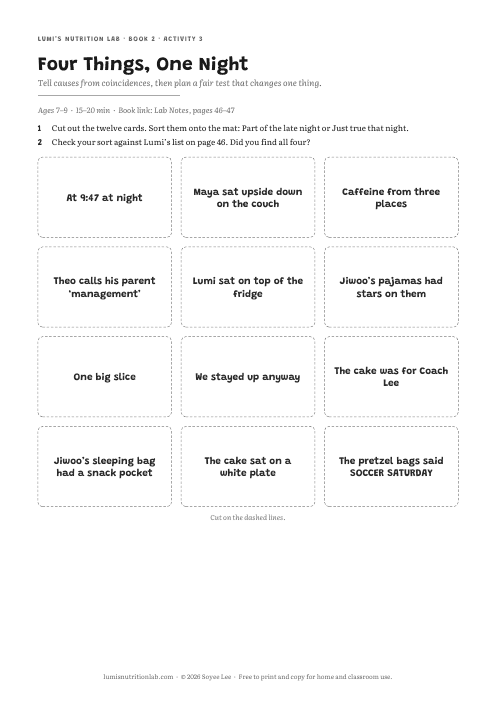
- Cut out the twelve cards. Sort them onto the mat: Part of the late night or Just true that night.
- Check your sort against Lumi’s list on page 46. Did you find all four?
- Look at the Coach Lee card again. It didn’t keep anyone awake — but it still mattered. Why isn’t it in Lumi’s file? (Page 49: “It wasn’t about bodies.”)
- Pick ONE of the four to change and fill in the fair-test strip: I will change… I will keep the same… I will notice…
Change one thing at a time. Change all four and you learn nothing. — L.
For the grown-up: The point is the method, not the food. Keep the fair test on paper — no tasting is needed or wanted. Lumi’s own testing order is on page 47.
ACTIVITY 4
Label Detective: SOCCER SATURDAY
Ages 7–9 · 20 min · Book link: Chapter 3 and Lab Notes, pages 40–41
Notice what the words on a package tell you — and what they leave out.
You need: Printable label sheet, pencils; optional: one real package from home
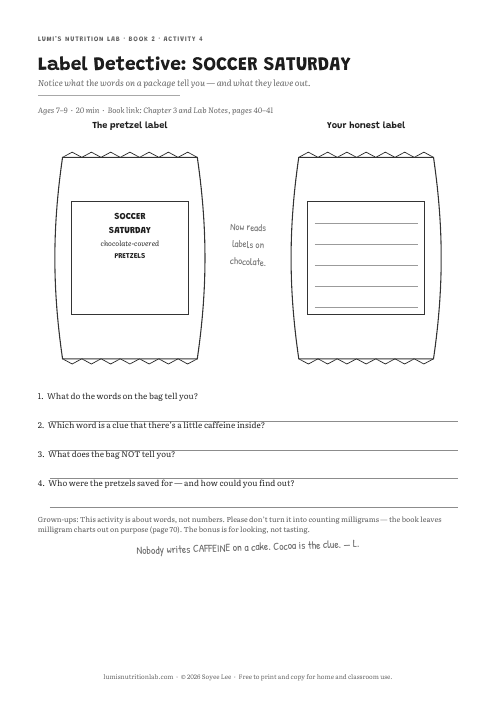
- Read the pretzel label on the sheet. In the story, the bags are labeled SOCCER SATURDAY. What do those words tell you?
- Detective questions: Which word is a clue that there’s a little caffeine inside? What does the bag not tell you? Who were the pretzels saved for?
- Design an honest label for the bag — one that would help at 9:47 at night. Lumi’s case file on page 40 might help: “Subject status: Rested. Now reads labels on chocolate.”
- Bonus, with a grown-up: look at one real package at home. Can you find a clue word from the list on page 66 — like cocoa, cola or coffee?
Nobody writes CAFFEINE on a cake. Cocoa is the clue. — L.
For the grown-up: This activity is about words, not numbers. Please don’t turn it into counting milligrams — the book leaves milligram charts out on purpose (page 70). The bonus is for looking, not tasting.
ACTIVITY 5
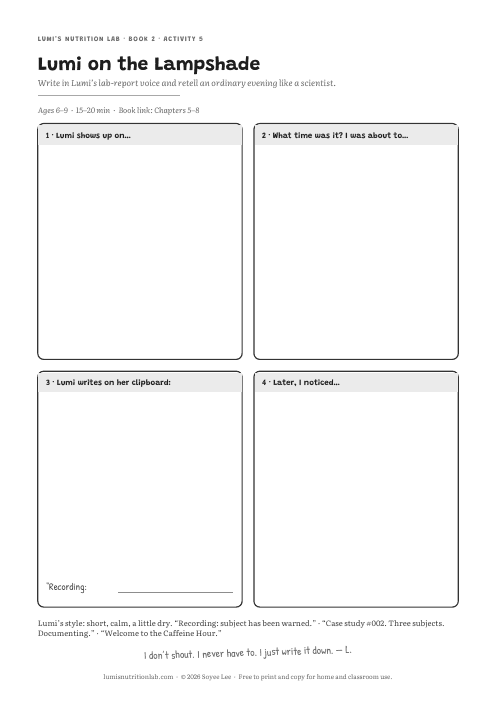
Lumi on the Lampshade
Ages 6–9 · 15–20 min · Book link: Chapters 5–8
Write in Lumi’s lab-report voice and retell an ordinary evening like a scientist.
You need: Printable four-panel comic sheet
- Panel 1: Lumi shows up somewhere in YOUR evening — a lampshade, a bookshelf, the top of the fridge.
- Panel 2: what time was it, and what were you about to do?
- Panel 3: what does Lumi write on her clipboard? Use her style: short, calm, a little dry. “Recording: subject has been warned.” “Case study #002. Three subjects. Documenting.”
- Panel 4: what did you notice later — at bedtime, or the next morning?
I don’t shout. I never have to. I just write it down. — L.
For the grown-up: Any answer works, including “Subject brushed teeth. Nothing to report.” That is still data.
ACTIVITY 6
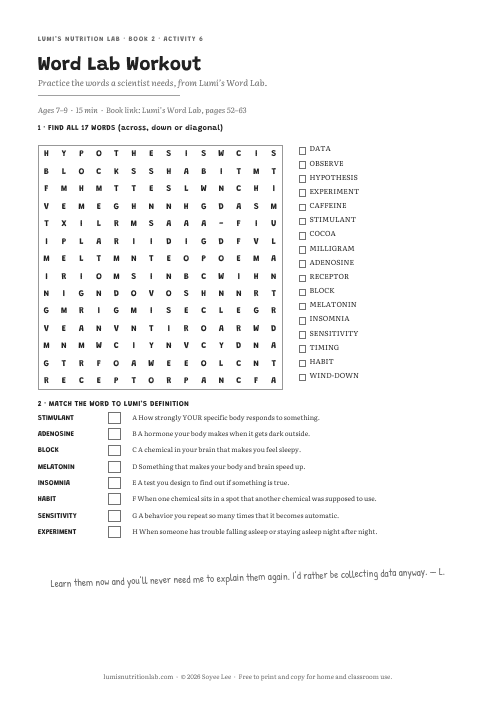
Word Lab Workout
Ages 7–9 · 15 min · Book link: Lumi’s Word Lab, pages 52–63
Practice the words a scientist needs, from Lumi’s Word Lab.
You need: Printable puzzle sheet
- Find all seventeen words in the word search.
- Match eight words to Lumi’s definitions.
- Bonus: explain Jiwoo’s night to someone at home using three of the words — try ADENOSINE, BLOCK and TIMING.
Learn them now and you’ll never need me to explain them again. I’d rather be collecting data anyway. — L.
For the grown-up: The answers are on the second page — no peeking, junior scientists. The grid holds seventeen of the twenty Word Lab words: SLEEPINESS SIGNAL is too long to fit, and CASE STUDY and SUBJECT sit this one out.
ACTIVITY 7
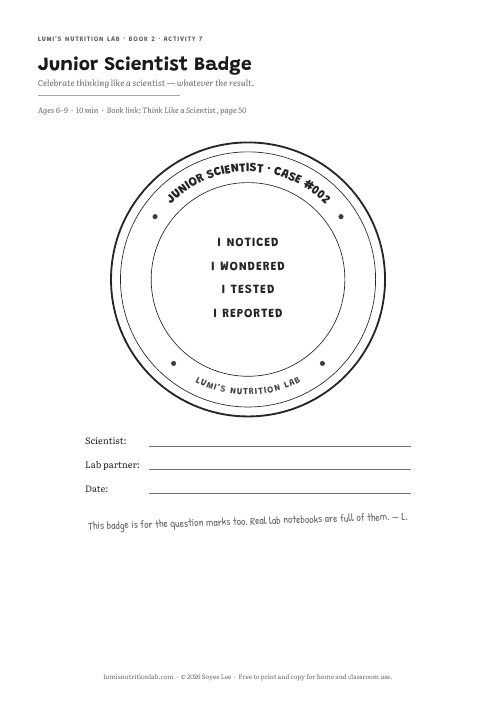
Junior Scientist Badge
Ages 6–9 · 10 min · Book link: Think Like a Scientist, page 50
Celebrate thinking like a scientist — whatever the result.
You need: Printable badge, coloring pencils
- Color the badge.
- Sign it — and have your lab partner sign too.
This badge is for the question marks too. Real lab notebooks are full of them. — L.
For the grown-up: Give it for honest observing, not for finishing a streak. Question marks and blank days count.