ACTIVITY 1
Draw the Gap
Ages 7–9 · 15 min · Book link: Lab Notes, page 41
Read a two-line graph and connect it to the story.
You need: Printable graph sheet, two colored pencils
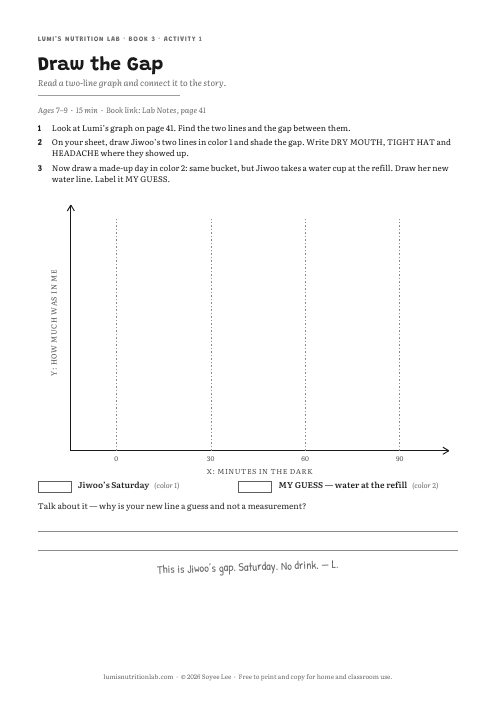
- Look at Lumi’s graph on page 41. Find the two lines and the gap between them.
- On your sheet, draw Jiwoo’s two lines in color 1 and shade the gap. Write DRY MOUTH, TIGHT HAT and HEADACHE where they showed up.
- Now draw a made-up day in color 2: same bucket, but Jiwoo takes a water cup at the refill. Draw her new water line. Label it MY GUESS.
- Talk about it: why is your new line a guess and not a measurement?
This is Jiwoo’s gap. Saturday. No drink. — L.
For the grown-up: There is no answer key. Many children draw the water line rising and the gap shrinking — that matches the idea in Lumi’s notes, but praise any line the child can explain. Like Lumi’s, the graph is a picture of an idea, not a measurement. A headache isn’t part of every thirst — Jiwoo happened to get one.
ACTIVITY 2
The Thirst Department Game
Ages 6–9 · 20–25 min · Book link: Chapter 6 and Lab Notes, pages 42–44
Model how salt pulls water out of cells, how the Thirst Department rings the bell — and why nobody hears it when attention is somewhere else.
You need: 20 paper salt squares (printable), three spots labeled BLOOD, CELLS and WATER CUPS, role cards, two paper flags, a bell if you have one
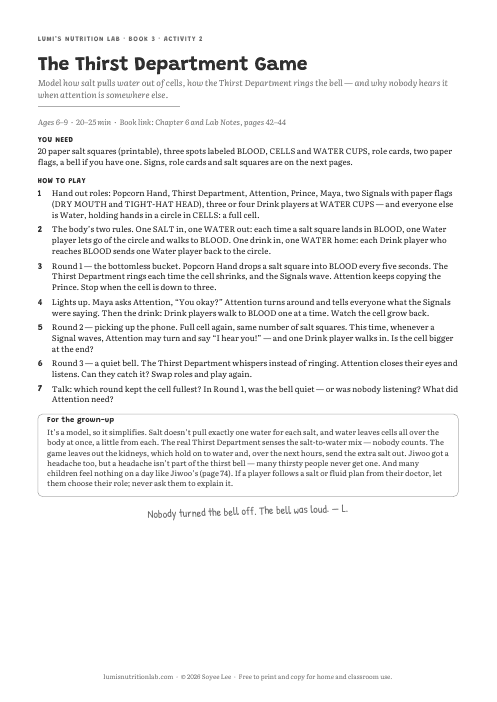
- Hand out roles: Popcorn Hand, Thirst Department, Attention, Prince, Maya, two Signals with paper flags (DRY MOUTH and TIGHT-HAT HEAD), three or four Drink players at WATER CUPS — and everyone else is Water, holding hands in a circle in CELLS: a full cell.
- The body’s two rules. One SALT in, one WATER out: each time a salt square lands in BLOOD, one Water player lets go of the circle and walks to BLOOD. One drink in, one WATER home: each Drink player who reaches BLOOD sends one Water player back to the circle.
- Round 1 — the bottomless bucket. Popcorn Hand drops a salt square into BLOOD every five seconds. The Thirst Department rings each time the cell shrinks, and the Signals wave. Attention keeps copying the Prince. Stop when the cell is down to three.
- Lights up. Maya asks Attention, “You okay?” Attention turns around and tells everyone what the Signals were saying. Then the drink: Drink players walk to BLOOD one at a time. Watch the cell grow back.
- Round 2 — picking up the phone. Full cell again, same number of salt squares. This time, whenever a Signal waves, Attention may turn and say “I hear you!” — and one Drink player walks in. Is the cell bigger at the end?
- Round 3 — a quiet bell. The Thirst Department whispers instead of ringing. Attention closes their eyes and listens. Can they catch it? Swap roles and play again.
- Talk: which round kept the cell fullest? In Round 1, was the bell quiet — or was nobody listening? What did Attention need?
Nobody turned the bell off. The bell was loud. — L.
For the grown-up: It’s a model, so it simplifies. Salt doesn’t pull exactly one water for each salt, and water leaves cells all over the body at once, a little from each. The real Thirst Department senses the salt-to-water mix — nobody counts. The game leaves out the kidneys, which hold on to water and, over the next hours, send the extra salt out. Jiwoo got a headache too, but a headache isn’t part of the thirst bell — many thirsty people never get one. And many children feel nothing on a day like Jiwoo’s (page 74). If a player follows a salt or fluid plan from their doctor, let them choose their role; never ask them to explain it.
ACTIVITY 3
The Paradox Sort
Ages 7–9 · 15–20 min · Book link: Lab Notes, pages 41–47, and page 70
Tell causes from coincidences, then plan a fair test that changes one thing.
You need: Printable cards and sorting mat, scissors
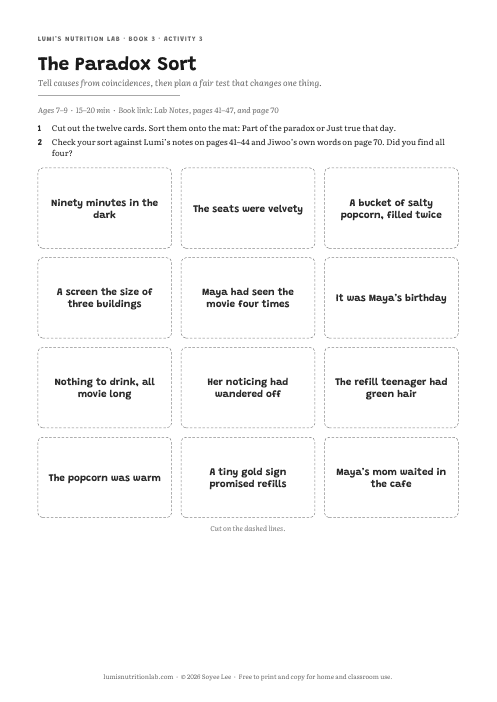
- Cut out the twelve cards. Sort them onto the mat: Part of the paradox or Just true that day.
- Check your sort against Lumi’s notes on pages 41–44 and Jiwoo’s own words on page 70. Did you find all four?
- Split your four: which made the thirst, and which made the not-noticing? (Page 44.) And the gold-sign card: it put no salt in Jiwoo’s blood — but did it change what she did?
- Pick ONE of the four to change and fill in the fair-test strip: I will change… I will keep the same… I will notice… Lumi’s questions on page 47 can help.
The salt made the thirst. The attention made the not-noticing. Two questions. Two answers. — L.
For the grown-up: The point is the method, not the snack. Keep the fair test on paper — no tasting is needed or wanted. The book’s own verdict is “Not the popcorn”: it was a combination, plus a wandering mind.
ACTIVITY 4
Sign Detective: BOTTOMLESS REFILLS
Ages 7–9 · 20 min · Book link: Chapter 1 and Lab Notes, page 41
Notice what a sign promises — and what it leaves out.
You need: Printable sign sheet, pencils; optional: one real package or sign from home
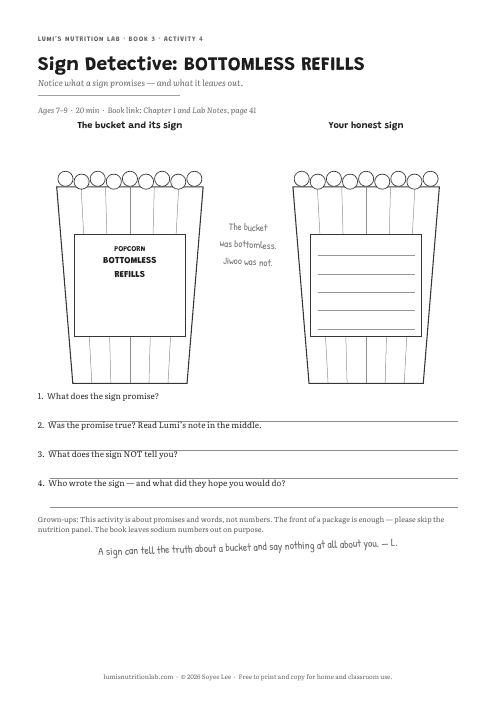
- Read the bucket and its sign on the sheet. What does the word bottomless make you imagine? (Jiwoo imagined “a magic well” — page 4.)
- Detective questions: Was the promise true? What ran out — the bucket, or Jiwoo? What does the sign not tell you? Who wrote it, and what did they hope you would do?
- Design an honest sign for the snack counter. Lumi’s notes on page 41 might help: “The bucket was bottomless. Jiwoo was not.”
- Bonus, with a grown-up: find one sign or package with a big promise word — new, giant, unlimited. Is it a promise about the thing, or about you?
A sign can tell the truth about a bucket and say nothing at all about you. — L.
For the grown-up: This activity is about promises and words, not numbers. The front of a package is enough — please skip the nutrition panel. The book leaves sodium numbers out on purpose.
ACTIVITY 5
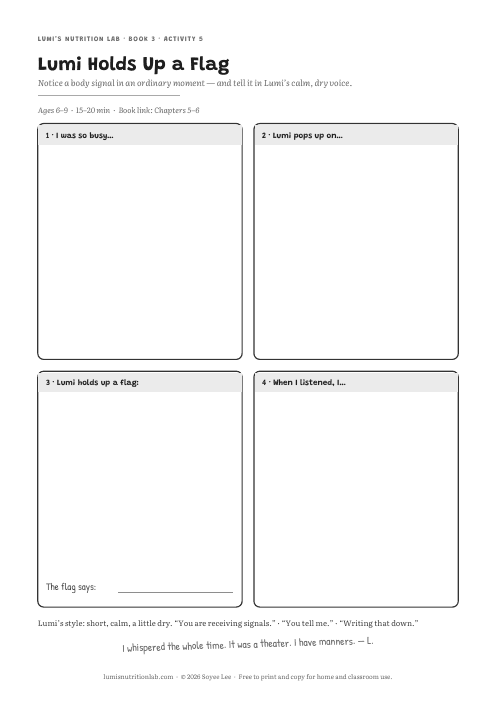
Lumi Holds Up a Flag
Ages 6–9 · 15–20 min · Book link: Chapters 5–6
Notice a body signal in an ordinary moment — and tell it in Lumi’s calm, dry voice.
You need: Printable four-panel comic sheet
- Panel 1: draw yourself busy — a game, a book, a movie, a block tower.
- Panel 2: Lumi pops up somewhere in your day — an armrest, a cup holder, a pencil case.
- Panel 3: Lumi holds up a flag. What was your body texting you? Hungry, tired, itchy, need a stretch — or nothing at all.
- Panel 4: what did you do when you finally listened?
I whispered the whole time. It was a theater. I have manners. — L.
For the grown-up: Any signal works — including a blank flag. That is still data. Keep it about how bodies feel, not about food.
ACTIVITY 6
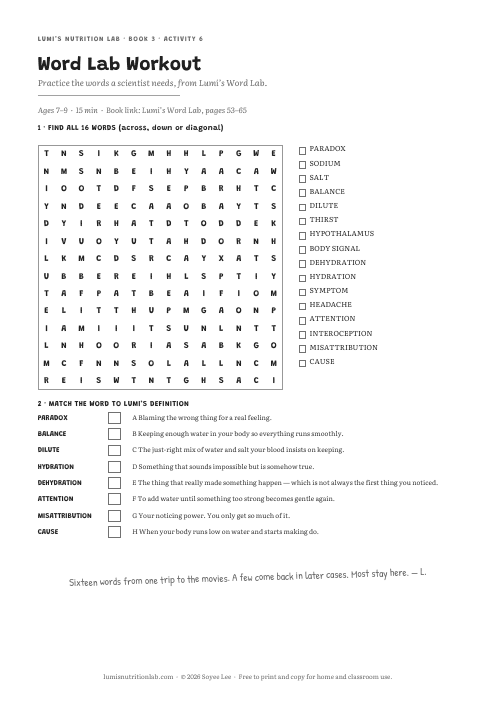
Word Lab Workout
Ages 7–9 · 15 min · Book link: Lumi’s Word Lab, pages 53–65
Practice the words a scientist needs, from Lumi’s Word Lab.
You need: Printable puzzle sheet
- Find all sixteen words from this case in the word search.
- Match eight words to Lumi’s definitions.
- Pick two words. Use each one in a sentence about Jiwoo’s day at the movies.
Sixteen words from one trip to the movies. A few come back in later cases. Most stay here. — L.
For the grown-up: The answers are on the second page — no peeking, junior scientists.
ACTIVITY 7
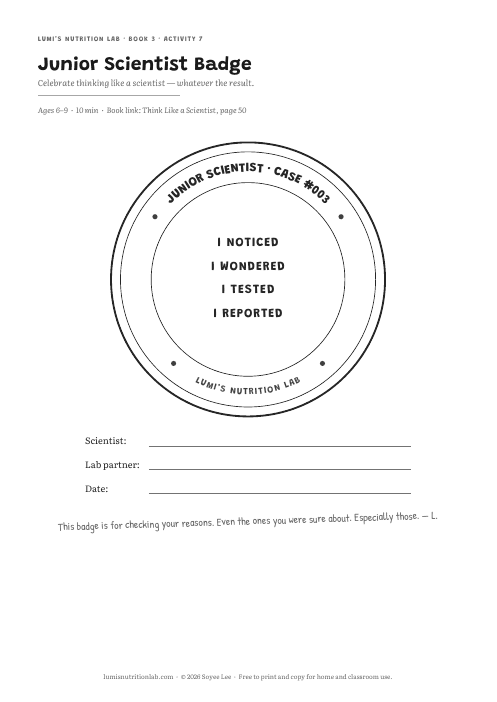
Junior Scientist Badge
Ages 6–9 · 10 min · Book link: Think Like a Scientist, page 50
Celebrate thinking like a scientist — whatever the result.
You need: Printable badge, coloring pencils
- Color the badge.
- Sign it — and have your lab partner sign too.
This badge is for checking your reasons. Even the ones you were sure about. Especially those. — L.
For the grown-up: Give it for honest observing, not for filling every row. Blank days count.